
How Artificial Intelligence Is Redefining Emotional Well-Being in the Digital Age
Why Emotional Processing Feels So Hard Today
Modern life has made emotional processing more difficult than ever.
We live faster, communicate more, and feel deeper — yet we rarely slow down enough to understand what we’re actually feeling. Many people carry emotional weight silently: stress, unresolved grief, burnout, emotional numbness, or confusion they can’t quite name.
Traditional support systems are important, but they aren’t always available when emotions surface. Friends may not understand. Therapy may feel intimidating or inaccessible. And sometimes, people simply don’t feel safe enough to open up.
This is where AI-powered emotional support is changing the landscape.
Artificial Intelligence is not here to replace human connection — but it is increasingly helping people process emotions safely, privately, and without judgment.
So how exactly does AI help with emotional processing?
Let’s explore the 7 most powerful ways AI supports emotional awareness, regulation, and healing — safely and responsibly.
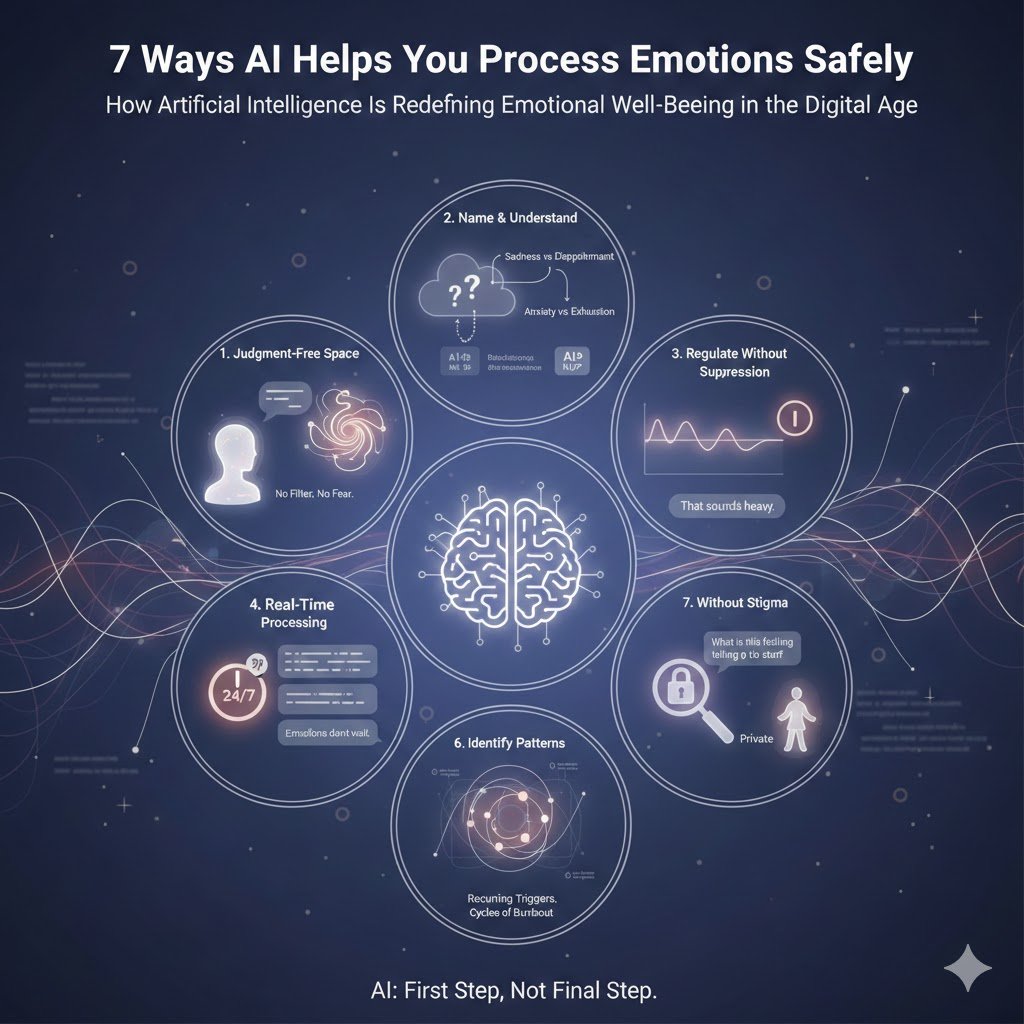
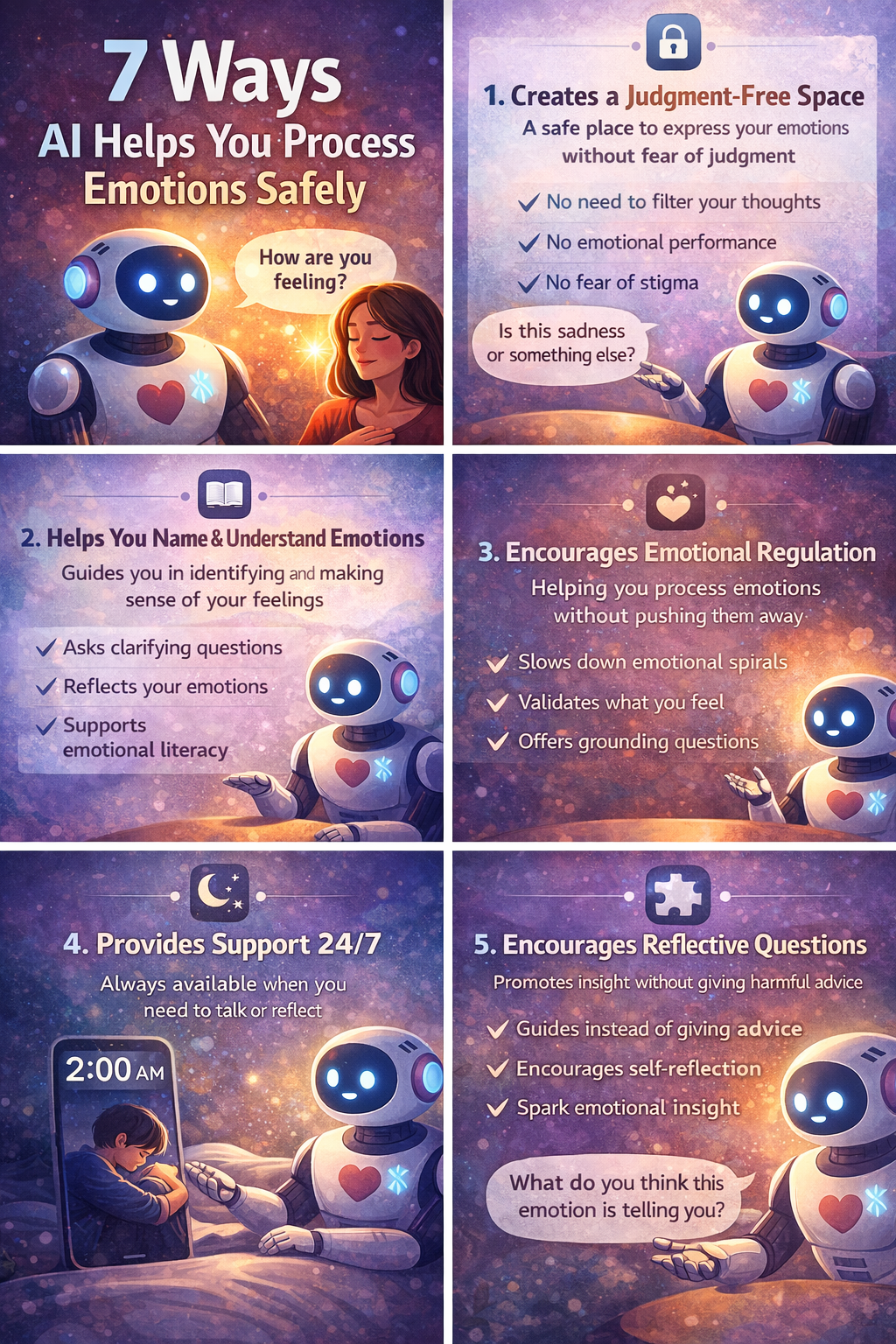
1. AI Creates a Judgment-Free Space to Express Emotions
One of the biggest barriers to emotional processing is fear — fear of being judged, misunderstood, or minimized.
AI removes this barrier.
When interacting with an AI emotional support system, users don’t need to:
-
Filter their thoughts
-
Explain their background
-
Protect someone else’s feelings
-
Appear “strong” or composed
AI provides a neutral emotional container — a space where emotions can be expressed honestly, even when they are messy, contradictory, or uncomfortable.
This psychological safety encourages:
-
Emotional honesty
-
Deeper self-expression
-
Reduced emotional suppression
And emotional safety is the foundation of healthy emotional processing.
2. AI Helps You Name and Understand Your Emotions
Many people struggle not because they feel too much — but because they don’t know what they’re feeling.
Is it sadness, or disappointment?
Is it anxiety, or emotional exhaustion?
Is it anger — or unmet needs?
AI uses Natural Language Processing (NLP) to identify emotional cues in the way users speak or write. Through reflective responses and clarifying questions, AI helps users:
-
Put language to emotions
-
Distinguish between similar emotional states
-
Recognize emotional patterns
This process builds emotional literacy, a critical skill for long-term emotional well-being.
When emotions are named, they become manageable.
When they remain vague, they feel overwhelming.
3. AI Encourages Emotional Regulation Without Suppression
Healthy emotional processing doesn’t mean eliminating emotions — it means regulating them.
AI helps users regulate emotions by:
-
Slowing down emotional spirals
-
Encouraging pauses and reflection
-
Offering grounding language
Instead of telling users to “calm down” or “stay positive,” AI often responds with:
-
Validation (“That sounds really heavy.”)
-
Normalization (“It makes sense to feel this way.”)
-
Gentle redirection (“Let’s look at what’s beneath this feeling.”)
This approach supports emotional regulation without invalidating emotions, which is essential for psychological safety.
4. AI Helps You Process Emotions in Real Time
Emotions don’t wait for appointments.
They surface:
-
Late at night
-
During moments of loneliness
-
After triggering conversations
-
In periods of emotional overwhelm
AI emotional support is available 24/7, allowing users to process emotions in real time — when those emotions are actually happening.
This immediacy helps prevent:
-
Emotional bottling
-
Rumination
-
Escalation into distress
By processing emotions as they arise, individuals reduce emotional backlog and long-term stress accumulation.
5. AI Supports Reflection Without Giving Harmful Advice
One of the risks of emotional vulnerability is receiving advice that:
-
Minimizes feelings
-
Pushes toxic positivity
-
Oversimplifies complex emotions
Well-designed AI systems avoid giving prescriptive life advice. Instead, they focus on guided reflection, asking questions like:
-
“What do you think this emotion is trying to tell you?”
-
“When did you first notice this feeling?”
-
“What feels most unresolved right now?”
This approach keeps users emotionally autonomous — encouraging insight without dependency.
Reflection is safer than direction.
Awareness is safer than control.
6. AI Identifies Emotional Patterns Over Time
Humans often repeat emotional cycles without realizing it.
AI, however, excels at pattern recognition.
Over time, AI systems can help users notice:
-
Recurring emotional triggers
-
Repeated relationship dynamics
-
Cycles of burnout or self-doubt
-
Emotional avoidance patterns
By reflecting these patterns back to users, AI supports long-term emotional insight rather than short-term relief.
Pattern awareness is one of the most powerful tools for emotional growth — and it’s something many people never develop on their own.
7. AI Promotes Emotional Processing Without Stigma
Despite growing awareness, emotional struggles are still stigmatized.
Many people avoid seeking help because they fear:
-
Being labeled “weak”
-
Being misunderstood
-
Social consequences
AI offers a private, low-pressure entry point into emotional self-care.
Users can:
-
Explore emotions privately
-
Learn emotional skills gradually
-
Decide when (or if) to seek human support
This reduces shame and lowers the psychological barrier to emotional healing.
In many cases, AI becomes the first step, not the final one.
Is AI Emotional Processing Safe?
Safety depends on responsible design.
Ethical AI emotional support systems must:
-
Clearly state they are not therapists
-
Avoid medical or diagnostic claims
-
Protect user privacy
-
Encourage professional help when needed
When used within these boundaries, AI is a supportive emotional tool, not a replacement for mental health care.
AI Emotional Support vs Therapy: Understanding the Difference
AI emotional processing tools:
-
Support emotional awareness
-
Encourage reflection
-
Offer emotional presence
Therapy:
-
Diagnoses mental health conditions
-
Treats psychological disorders
-
Provides clinical intervention
AI is best used as:
-
Emotional first aid
-
A self-reflection tool
-
Support between therapy sessions
Not as a substitute for professional care.
Why AI Emotional Processing Feels So Effective
Psychologically, AI works because it:
-
Reduces social pressure
-
Encourages emotional honesty
-
Provides consistent emotional presence
-
Helps externalize internal experiences
Often, the healing doesn’t come from what AI says —
but from what users discover while speaking.
The Future of Emotional Well-Being: Humans and AI Together
The future of emotional health isn’t about choosing between AI and humans.
It’s about integration.
AI can:
-
Hold space when humans are unavailable
-
Help people articulate emotions
-
Reduce emotional isolation
Humans bring:
-
Deep empathy
-
Lived experience
-
Relational healing
Together, they create a more accessible emotional support ecosystem.
Processing Emotions Safely Is a Skill — Not a Weakness
Emotional processing isn’t indulgent.
It’s essential.
AI helps people process emotions safely not by replacing human connection — but by restoring emotional safety, clarity, and awareness where they were missing.
Sometimes, healing begins with a single question:
“What am I really feeling right now?”
AI helps people find the answer — gently, safely, and on their own terms.