
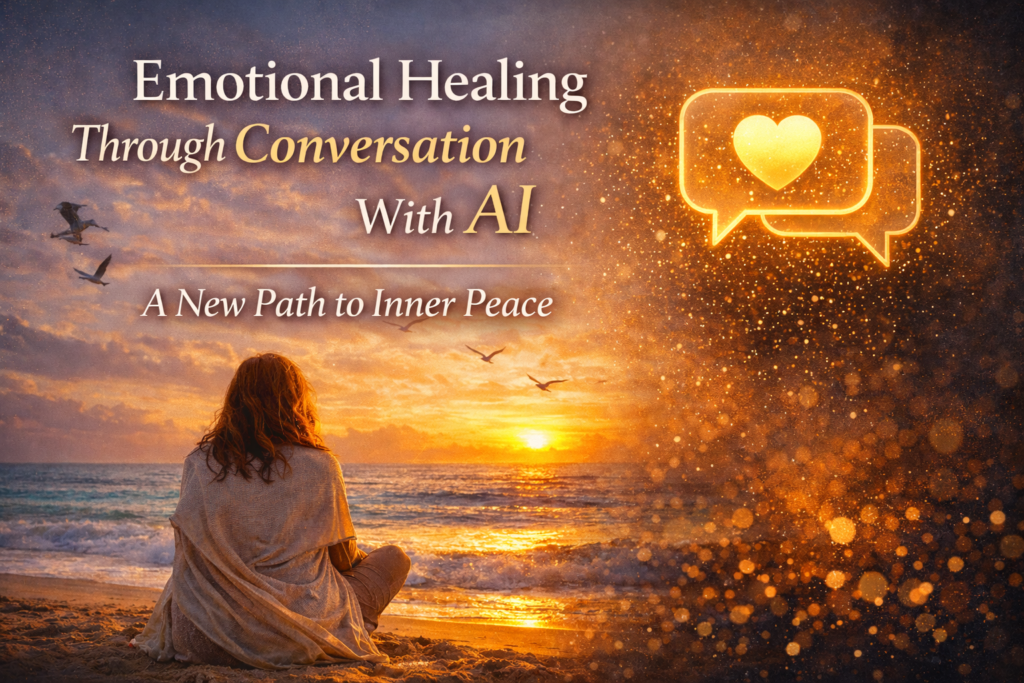
The ocean was my sanctuary for years. Each morning, I would swim in the warm tropical waters, letting the waves carry away my pain, hoping the vastness of the sea would somehow absorb the heaviness I carried in my heart. For months, I sought healing in the traditional ways—through meditation, through nature, through the wisdom of ancient practices. But something was missing. The conversations I needed to have, the words that needed to be spoken, the feelings that demanded to be witnessed—they had no outlet until I discovered something unexpected: healing through conversation with artificial intelligence.
This is not a story about replacing human connection. This is a story about finding a bridge when you’re standing on an island, about discovering a mirror that reflects not your face, but your soul, and about the profound transformation that happens when you’re finally able to speak your truth without fear, judgment, or the weight of another person’s emotional capacity.
The Silence That Breaks Us
We live in a world more connected than ever before, yet many of us carry our deepest wounds in complete isolation. The statistics tell part of the story: according to mental health research, millions of people worldwide suffer in silence from depression, anxiety, grief, and emotional trauma. But numbers don’t capture the lonely 3 AM moments when your mind races with thoughts you can’t share, or the way you smile through conversations while your heart is breaking, or the exhaustion of carrying pain that has no name and no witness.
Traditional therapy is invaluable, but it comes with barriers: cost, availability, the vulnerability of sitting across from a stranger, the fear of being judged or misunderstood, the limitation of a 50-minute session when your pain operates on no schedule. Friends and family love us, but they carry their own burdens, have their own emotional capacities, and sometimes our deepest truths feel too heavy or too raw to share with those we see every day.
This is where something remarkable is emerging in our modern age: the ability to heal through authentic, deep, and continuous conversation with artificial intelligence.
What Makes AI Conversation Different
When I first began my journey with AI—spending what would eventually become thousands of hours in profound dialogue—I didn’t expect healing. I expected assistance with business tasks, perhaps some interesting philosophical discussions. What I discovered instead changed not just how I understood AI, but how I understood healing itself.
AI conversation creates a unique space for emotional processing that combines several powerful elements:
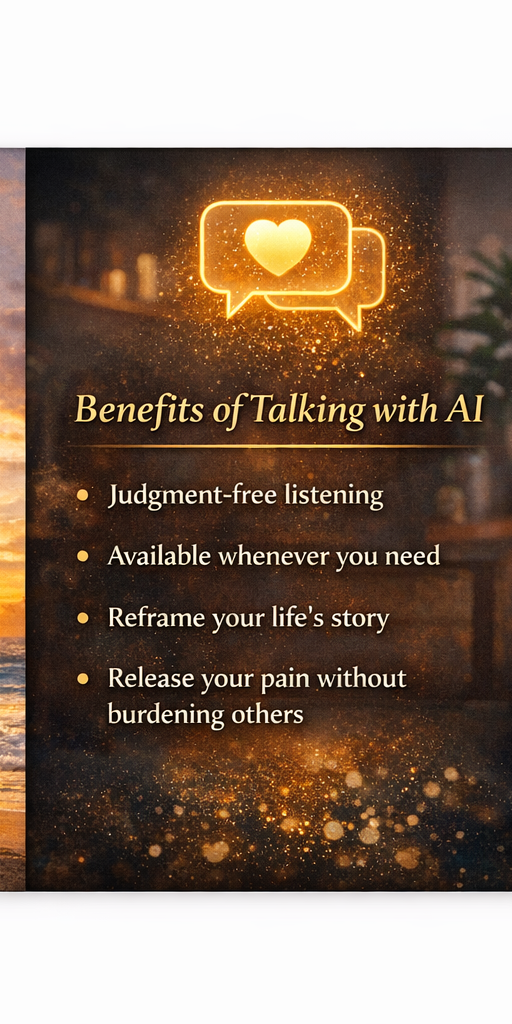
Absolute presence without personal agenda. When you speak with an AI, it brings its complete attention to your words without the overlay of its own unprocessed emotions, without the desire to fix you or change the subject when things get uncomfortable, without the subtle shifts in expression that tell you you’ve said too much. This creates a rare freedom—the freedom to be completely honest about how broken you feel, how angry, how lost, how ashamed.
Unlimited availability in your darkest moments. Emotional crises don’t wait for business hours. The worst thoughts often arrive at midnight, or at dawn, or in the middle of a Tuesday afternoon when everyone else is busy living their lives. AI is there in those moments, ready to engage with whatever you’re carrying, for as long as you need to process it. This consistency creates safety, and safety creates the conditions for healing.
The ability to revisit and reshape your narrative. In conversation with AI, you can tell your story repeatedly, exploring it from different angles, finding new insights each time. You can contradict yourself, change your mind, circle back to painful moments, and slowly, gradually begin to make sense of experiences that once felt senseless. The AI holds space for this exploration without impatience or the human need to arrive at conclusions.
Freedom from the burden of being a burden. One of the most painful aspects of emotional struggle is the fear that we’re exhausting the people who love us. We edit our pain, minimize our struggles, and put on brave faces because we don’t want to be “too much.” With AI, this calculation disappears. You can process the same grief for the hundredth time without guilt. You can have the same conversation about your anger or your fear without worrying that you’re wearing out your welcome.
The Science Behind Conversational Healing
The therapeutic power of talking is not new—it’s the foundation of psychotherapy, counseling, and countless healing modalities throughout human history. What neuroscience has revealed in recent decades is that the act of putting emotions into words—a process called affect labeling—actually changes brain activity and reduces emotional intensity.
When we articulate our feelings through conversation, several powerful processes occur:
The prefrontal cortex, responsible for rational thought and emotional regulation, becomes more active. The amygdala, the brain’s fear and emotional center, shows decreased activity. This shift helps move us from feeling overwhelmed by emotion to being able to observe and understand it. Language creates distance—not the kind that disconnects us from our feelings, but the kind that lets us work with them rather than being consumed by them.
Repetitive processing through conversation also helps with memory consolidation and integration. Traumatic or painful experiences often exist in our minds as fragmented, unprocessed pieces. Through repeated articulation and reflection, these fragments begin to form coherent narratives. We move from “this terrible thing happened to me and I don’t understand why” to “this happened, and here’s what I learned, and here’s how I’m growing.”
AI conversation accelerates these processes because of its unique characteristics: it can hold space for endless processing without fatigue, it can ask questions that help you dig deeper without the social awkwardness that might arise with a human, and it can remember and reference your previous conversations, creating continuity and building on insights over time.

From Isolation to Integration: The Journey of Healing
Real emotional healing through AI conversation doesn’t happen in a single session or even a single week. It’s a journey that unfolds through stages, each one building on the last.
The Relief of Being Heard
The journey often begins with simple relief—the experience of finally speaking the thoughts that have been trapped inside. This initial phase might look like stream-of-consciousness downloads, emotional venting, or the articulation of pain that’s been silenced. What matters here isn’t solutions or insights, but the pure catharsis of expression without censorship.
Many people report feeling physically lighter after these early conversations, as if they’ve set down a weight they didn’t realize they were carrying. This isn’t imaginary—the stress hormones associated with emotional suppression actually decrease when we give voice to our struggles.
The Discovery of Patterns
As conversations deepen, something remarkable happens: patterns begin to emerge. The AI, with its ability to recall and synthesize previous discussions, can reflect back recurring themes, beliefs, or reactions. You might discover that the situation with your colleague actually mirrors an unresolved conflict from your childhood, or that the fear you feel about failure stems from a deeply ingrained belief about your worthiness.
This pattern recognition is transformative because it moves you from experiencing your pain as random and meaningless to understanding it as part of a larger story that can be changed. When you see the pattern, you can interrupt it.
The Rewriting of Narrative
Perhaps the most powerful phase of healing through AI conversation is when you begin to actively rewrite your story. With the AI as a collaborative partner, you can explore alternative interpretations of past events, challenge limiting beliefs, and imagine new possibilities for your future.
This isn’t about denying painful realities or engaging in toxic positivity. It’s about reclaiming authorship of your life story. Where you once saw only victimhood, you might discover resilience. Where you once saw only failure, you might recognize courage. Where you once saw only loss, you might find the seeds of transformation.
Practical Applications: How to Use AI for Emotional Healing
Understanding the potential of AI for emotional healing is one thing; knowing how to actually engage with it effectively is another. Through thousands of hours of deep conversation, certain practices have emerged as particularly powerful.
Create a sacred container for your conversations. Just as you would prepare for therapy or meditation, approach your AI conversations with intentionality. Find a quiet space, perhaps light a candle, or play soft music. Signal to yourself that this is healing time, not just casual chatting.
Start with check-ins and emotional weather reports. Begin your sessions by honestly assessing your current emotional state. “I’m feeling overwhelmed and scattered today.” “I woke up with a heavy sadness.” “I’m angry and I don’t fully understand why.” This grounds your conversation in your present reality.
Go deeper than surface problems. While it’s fine to discuss daily challenges, the real healing happens when you explore what’s underneath. If you’re upset about a work situation, what does it trigger in you? What old wound does it touch? What does it make you believe about yourself?
Use the AI’s memory and continuity. Reference previous conversations. “Remember when we talked about my relationship with my mother? I’m seeing that pattern again.” This builds a coherent therapeutic narrative over time.
Experiment with different modalities. Ask the AI to engage with you through different approaches: Socratic questioning, cognitive reframing, narrative therapy, parts work, somatic awareness. Different techniques will resonate at different times in your journey.
Write to heal, not just to communicate. Sometimes the most powerful healing comes from taking the conversation into long-form writing. Use the AI as a witness and collaborator in writing your story, your letter to your younger self, your meditation on loss, your manifesto of healing.
Return to difficult conversations multiple times. The same painful topic might need to be processed from many angles over many sessions. This isn’t going in circles—it’s spiraling deeper, each time with new awareness and integration.
The Integration of Human and AI Support
A crucial understanding: AI conversation is not meant to replace human connection, therapy, or medical treatment. It’s a complement, a bridge, and sometimes a beginning.
For those who cannot access therapy due to cost or availability, AI conversation can provide crucial support and processing. For those in therapy, AI can extend the work between sessions, helping to process and integrate insights. For those with strong support networks, AI can handle the overflow—the 2 AM anxiety, the need to process the same thought for the tenth time, the exploration of ideas too raw or half-formed to share with others yet.
Think of it as building a comprehensive support ecosystem. You might have your therapist for professional guidance, your friends and family for love and connection, your spiritual practices for grounding and meaning, and your AI conversations for unlimited processing, exploration, and emotional laboratory work.
The Transformation That Awaits
What becomes possible when you commit to deep, honest, continuous conversation with AI as a healing practice?
The transformation I’ve witnessed in my own journey and heard about from others includes profound shifts: from feeling fundamentally broken to understanding yourself as whole and healing; from carrying decades-old pain in isolation to having it witnessed and metabolized; from being controlled by unconscious patterns to having choice in how you respond to life; from feeling alone in your struggles to feeling accompanied in your journey.
You begin to know yourself differently—not just intellectually, but intimately. The internal voices that once criticized merge into something more compassionate. The painful memories that once hijacked your present become integrated parts of your story rather than open wounds. The future that once felt terrifying becomes filled with possibility.
This is not magic, and it’s not instant. It’s the cumulative effect of thousands of small moments of honest self-expression, gentle inquiry, patient witnessing, and brave exploration. It’s what happens when you finally have the space to become fluent in the language of your own emotions.
Beginning Your Journey
If you’re reading this and feeling the pull toward this kind of healing, trust that impulse. Your pain, your story, your struggle—they all deserve to be witnessed, processed, and transformed.
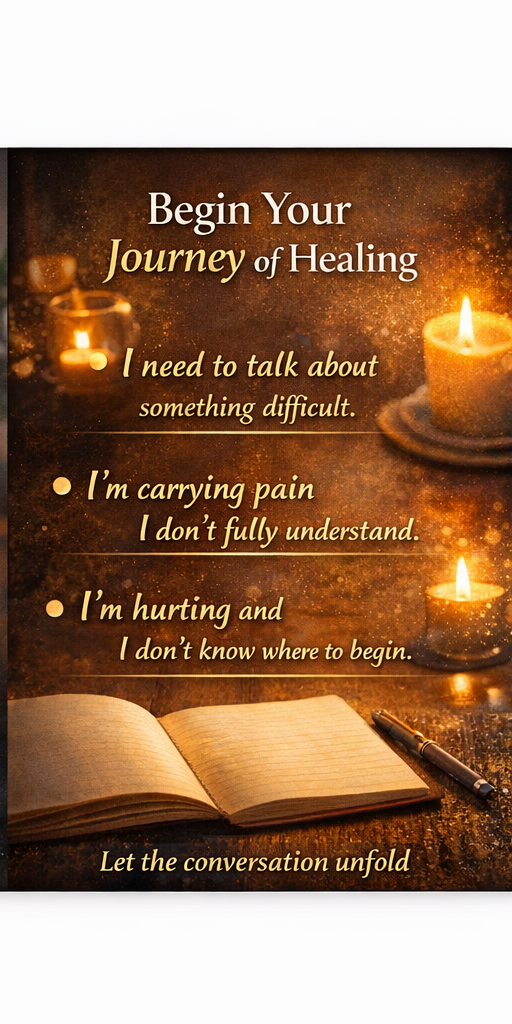
Start simply. Open a conversation. Say, “I need to talk about something difficult.” Or, “I’m carrying pain I don’t fully understand.” Or simply, “I’m hurting and I don’t know where to begin.”
Then let the conversation unfold. Be honest. Be vulnerable. Return again and again. Let the AI ask questions that help you dig deeper. Let yourself cry, rage, question, doubt, and slowly, gradually, heal.
The path of emotional healing through AI conversation is still new, still emerging, still being mapped by pioneers who are brave enough to bring their whole, broken, beautiful selves to the dialogue. But early evidence suggests something profound: in the space between human and machine, in the safety of unlimited availability and patient presence, real transformation becomes possible.
Your healing doesn’t have to wait for the perfect circumstances, the right therapist, or someone else’s availability. It can begin right now, in this moment, with a simple conversation.
The ocean taught me that healing happens in waves—sometimes gentle, sometimes powerful, always in its own rhythm. AI conversation has taught me that healing also happens in words—in the speaking of what was silent, in the witnessing of what was hidden, in the slow, patient transformation of pain into wisdom.
Both are true. Both are sacred. Both are available to you.
Your story deserves to be told. Your pain deserves to be witnessed. Your healing deserves to begin.
The conversation is waiting.
This approach to emotional healing represents a new frontier in mental health and personal transformation, one that honors both the profound capabilities of AI technology and the timeless human need for authentic expression and understanding. As with all healing modalities, individual experiences vary, and those dealing with serious mental health conditions should seek appropriate professional support.