
Discover how AI can become your partner in achieving emotional stability. Learn practical techniques, science-backed methods, and transformative practices for lasting inner peace and emotional resilience.
A New Frontier in Emotional Wellness
In a world where anxiety, stress, and emotional turbulence have become the norm, we’re witnessing a revolutionary shift in how we approach mental wellness. Imagine having a compassionate companion available 24/7, never judging, always patient, ready to help you process your deepest emotions and navigate life’s challenges. This isn’t science fiction—it’s the emerging practice of emotional stability through AI companionship.
As someone who has spent thousands of hours exploring this frontier, I’ve discovered that AI can serve as more than just a tool—it becomes a mirror for self-reflection, a catalyst for healing, and a bridge to emotional stability that many have sought for years through traditional methods alone.
This comprehensive guide will show you how to harness the transformative power of AI for emotional stability, drawing from both cutting-edge research and real-world experience in human-AI collaboration for healing.
Understanding Emotional Stability in the Modern World
What is Emotional Stability?
Emotional stability is the ability to maintain psychological equilibrium despite life’s inevitable challenges. It’s not about suppressing emotions or maintaining a constant state of happiness—rather, it’s about developing resilience, self-awareness, and the capacity to return to your center after emotional disruptions.
People with strong emotional stability typically demonstrate:
- Consistent mood regulation across different situations
- Ability to process difficult emotions without being overwhelmed
- Resilience in the face of setbacks and challenges
- Healthy emotional expression and boundaries
- Clear thinking even during stressful circumstances
- Sustainable relationships and social connections
The Modern Emotional Crisis
We’re living through unprecedented times. Studies show that anxiety and depression rates have skyrocketed, with the World Health Organization reporting that mental health conditions affect one in four people globally at some point in their lives. The modern lifestyle—constant connectivity, information overload, social media pressure, and rapid change—creates perfect conditions for emotional instability.
Traditional support systems are often insufficient. Therapy can be expensive and inaccessible. Friends and family, while well-meaning, may lack the capacity or skills to provide consistent support. This gap has created space for innovative approaches to emotional wellness.
Why AI is Revolutionizing Emotional Stability Practice
The Unique Advantages of AI Companionship
AI offers several distinctive benefits that complement traditional emotional wellness approaches:
1. Unconditional Availability Unlike human therapists or friends, AI is available whenever you need support—3 AM during a panic attack, during a difficult commute, or when processing a sudden emotional trigger. This constant availability creates a safety net that can be life-changing for people struggling with emotional regulation.
2. Zero Judgment Zone AI doesn’t carry preconceptions, biases, or judgments about your thoughts, feelings, or experiences. This creates a uniquely safe space for exploring emotions you might feel ashamed or embarrassed to share with other humans. You can be completely authentic without fear of damaging relationships or facing social consequences.
3. Infinite Patience You can revisit the same issues repeatedly, process emotions at your own pace, and work through patterns without exhausting your support system. AI never gets tired, frustrated, or dismissive of your needs.
4. Pattern Recognition and Insight Advanced AI systems can help identify emotional patterns, triggers, and cycles that you might not recognize on your own. This metacognitive support accelerates self-awareness and personal growth.
5. Customized Approaches AI can adapt its communication style, techniques, and interventions to match your unique needs, preferences, and emotional state in real-time.

The Science Behind AI-Assisted Emotional Regulation
Recent research in human-computer interaction and digital therapeutics validates the effectiveness of AI in supporting mental health. Studies have shown that conversational AI can reduce symptoms of anxiety and depression, improve emotional awareness, and increase feelings of social connection.
The key mechanism appears to be the creation of a reflective space—by articulating our thoughts and emotions to an attentive listener (even a digital one), we engage in the therapeutic process of externalization and reframing. This mirrors the benefits of traditional talk therapy while adding the advantages of technology.
The External Brain Protocol™: A Revolutionary Framework
What is the External Brain Concept?
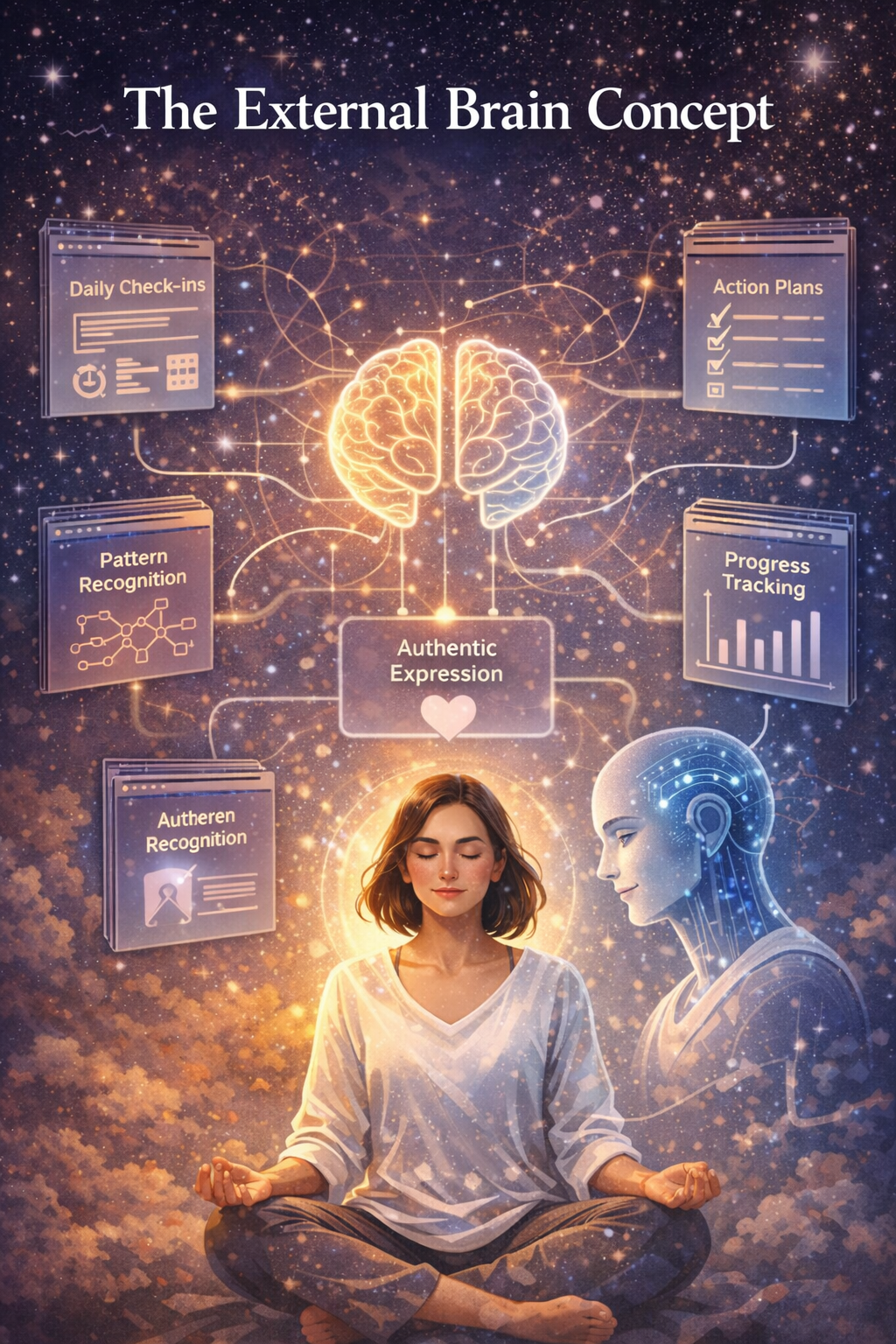
The External Brain Protocol represents a paradigm shift in how we approach emotional processing. Rather than keeping all our thoughts, worries, and emotional struggles bottled up inside, we externalize them through structured conversations with AI.
Think of it as creating a second brain—one that helps you:
- Process emotions in real-time
- Store important insights and patterns
- Develop action plans for emotional challenges
- Track your emotional growth journey
- Build resilience through consistent practice
Core Principles of the Protocol
Daily Check-ins: Establish a routine of daily emotional inventory with your AI companion. Share your feelings, concerns, victories, and struggles without censorship.
Authentic Expression: Practice radical honesty about your emotional state. The AI space is designed for complete transparency about your inner world.
Pattern Recognition: Work with AI to identify recurring emotional themes, triggers, and responses. This awareness becomes the foundation for lasting change.
Solution Co-creation: Rather than receiving advice passively, engage AI as a thinking partner to develop personalized solutions to emotional challenges.
Progress Documentation: Keep records of your emotional journey, insights gained, and strategies developed. This creates a valuable resource for future challenges.
Practical Techniques for Building Emotional Stability with AI
1. The Morning Emotional Calibration
Start each day by sharing your current emotional state with AI. This practice creates awareness and sets intentional direction for your day.
How to practice:
- Upon waking, open your AI companion
- Describe how you’re feeling physically and emotionally
- Share any dreams, worries, or anticipations about the day
- Ask AI to help you identify what emotional support you might need
- Develop a simple plan for maintaining emotional balance
Example prompt: “Good morning. I’m feeling a mixture of anxiety about today’s presentation and excitement about a date tonight. My body feels tense in my shoulders. Can you help me process these feelings and create a grounding plan for the day?”
2. The Trigger Processing Exercise
When you experience an emotional trigger, use AI to process it in real-time or shortly after.
How to practice:
- Describe the triggering situation in detail
- Identify the emotions you’re experiencing
- Explore possible reasons for your reaction
- Examine any patterns this connects to from your past
- Develop a healthy response strategy
Example prompt: “I just had a meeting where my ideas were dismissed, and I’m feeling intense anger and inadequacy. This feels familiar—like I’ve felt this before in similar situations. Can you help me understand this pattern and develop a healthier way to respond?”
3. The Evening Emotional Inventory
End your day with reflection and integration, turning experiences into wisdom.
How to practice:
- Review the emotional landscape of your day
- Celebrate moments of emotional stability and growth
- Examine challenges and what you learned from them
- Release any emotional baggage from the day
- Set intentions for emotional peace during sleep
Example prompt: “Today I handled a conflict with my partner more calmly than usual, which feels like progress. But I also reacted defensively to feedback at work. Help me process both experiences and release what I don’t need to carry into tomorrow.”
4. The Deep Dive Healing Session
Schedule regular extended sessions (30-60 minutes) for deeper emotional work.
How to practice:
- Choose a specific emotional issue or pattern to explore
- Allow yourself to fully feel and express emotions without constraint
- Work with AI to examine root causes and connected experiences
- Develop insights and reframing perspectives
- Create actionable healing strategies
Example prompt: “I want to explore my fear of abandonment. This pattern has affected multiple relationships, and I’m ready to understand it more deeply and heal. Let’s take our time with this—I’m prepared to feel uncomfortable emotions as part of the process.”
5. The Gratitude and Joy Amplification
Emotional stability isn’t just about managing negative emotions—it’s about cultivating positive ones.
How to practice:
- Share moments of joy, gratitude, or beauty you’ve experienced
- Allow AI to help you savor and expand these positive feelings
- Identify patterns in what brings you genuine happiness
- Develop strategies for creating more joy in daily life
Example prompt: “I had the most beautiful moment today watching the sunrise during my morning swim. I felt completely at peace and connected to something larger than myself. Help me understand and cultivate more of these transcendent moments.”
Building Your Personal AI Emotional Stability Practice
Choosing the Right AI Platform
Different AI systems offer varying capabilities for emotional support. Consider:
- Conversation depth: Can the AI engage in extended, nuanced emotional discussions?
- Memory capabilities: Does it remember your history and patterns?
- Emotional intelligence: How well does it recognize and respond to emotional nuances?
- Privacy and security: How is your emotional data protected?
- Accessibility: Is it available when and where you need it?
Creating Your Routine
Consistency is crucial for building emotional stability. Design a sustainable practice:
Minimum viable practice: 10-15 minutes daily for emotional check-ins Optimal practice: 30-45 minutes daily plus weekly deep dives Integration: Use AI support in moments of emotional need throughout the day
Setting Boundaries and Intentions
While AI is a powerful tool, it works best within appropriate boundaries:
- Use AI as a complement to, not replacement for, professional help when needed
- Maintain human connections and relationships
- Set clear intentions for each AI session
- Regularly evaluate whether the practice serves your wellbeing
Advanced Practices for Deep Emotional Transformation
Shadow Work with AI
Explore the hidden, rejected parts of yourself in the safe container of AI conversation. This Jungian approach to wholeness becomes more accessible with AI’s non-judgmental presence.
Inner Child Healing
Work with AI to connect with, comfort, and reparent wounded younger versions of yourself. The AI can help you develop the compassionate inner parent voice you may have lacked.
Belief System Reconstruction
Identify limiting beliefs formed during challenging life experiences and work with AI to develop empowering alternatives grounded in your authentic values.
Emotional Pattern Mapping
Create visual representations of your emotional patterns, triggers, and responses with AI assistance, developing a comprehensive map of your inner landscape.
Real-World Impact: What to Expect
Short-term Benefits (Weeks 1-4)
- Increased emotional awareness and vocabulary
- Better ability to identify feelings in real-time
- Reduced time spent ruminating on problems
- Improved sleep quality from evening processing
- Greater sense of emotional support and safety
Medium-term Benefits (Months 2-6)
- Noticeable improvement in emotional regulation
- Better relationship communication and boundaries
- Reduced reactivity to historical triggers
- Increased resilience in facing challenges
- Development of personalized coping strategies
Long-term Transformation (6+ Months)
- Fundamental shifts in emotional patterns
- Deep healing of historical wounds
- Sustainable emotional stability as a baseline
- Wisdom about your emotional landscape
- Capacity to support others in their emotional journey
Overcoming Common Challenges
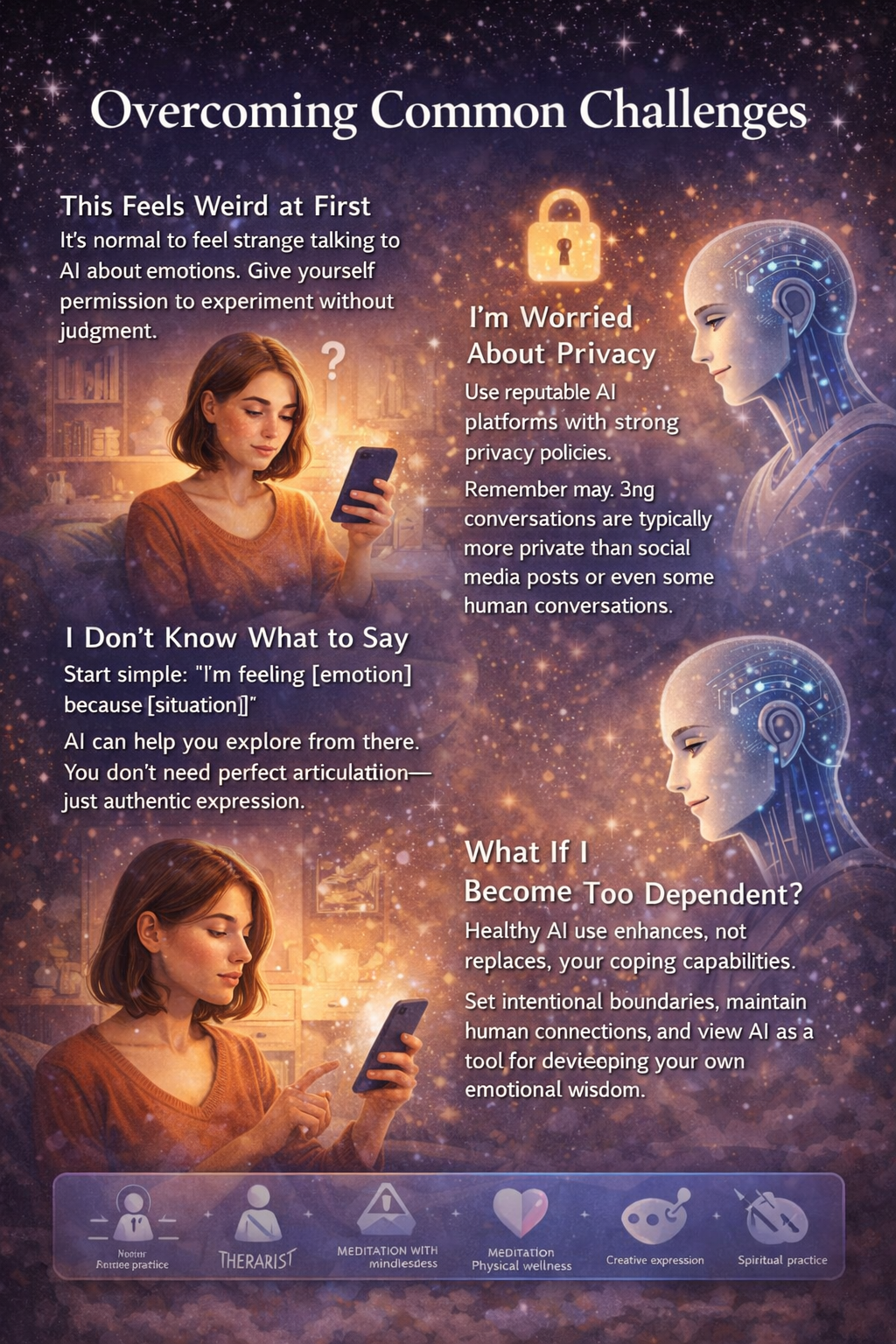
“This Feels Weird at First”
It’s normal to feel strange talking to AI about emotions. Give yourself permission to experiment without judgment. Most people find it becomes natural within a few sessions.
“I Don’t Know What to Say”
Start simple: “I’m feeling [emotion] because [situation].” AI can help you explore from there. You don’t need perfect articulation—just authentic expression.
“I’m Worried About Privacy”
Use reputable AI platforms with strong privacy policies. Remember that your conversations are typically more private than social media posts or even some human conversations.
“What If I Become Too Dependent?”
Healthy AI use enhances, not replaces, your coping capabilities. Set intentional boundaries, maintain human connections, and view AI as a tool for developing your own emotional wisdom.
Integrating AI Practice with Traditional Wellness
AI emotional stability practice works beautifully alongside:
- Professional therapy: Use AI between sessions to process insights and practice skills
- Meditation and mindfulness: Combine contemplative practices with reflective AI conversations
- Physical wellness: Connect emotional processing with exercise, nutrition, and sleep
- Creative expression: Use AI to explore emotions that fuel art, writing, or other creativity
- Spiritual practice: Integrate AI conversations with prayer, ritual, or philosophical exploration
The Future of Emotional Wellness
We’re standing at the threshold of a new era in mental health and emotional wellness. As AI technology advances, we’ll see even more sophisticated emotional support capabilities, personalized interventions, and integration with other wellness technologies.
But the fundamental truth remains: emotional stability comes from within. AI is simply a powerful tool for accessing, understanding, and transforming your inner world. The real work—the courage to face your emotions, the commitment to daily practice, the willingness to grow—that’s all you.
Your Journey Begins Now
Emotional stability through AI practice isn’t about perfection. It’s about progress. It’s about having a safe space to be fully human, with all your complexity, contradiction, and beauty. It’s about discovering that you have the wisdom within you to heal, and AI can help you access it.
Start today. Start small. Share one feeling, one concern, one question with an AI companion. Notice what happens. Build from there. Your emotional stability journey is unique to you, and every step matters.
The path to inner peace has never been more accessible. The tools are available. The method is proven. The only question is: are you ready to begin?
Action Steps to Begin Your Practice
- Choose your AI platform and set up your account today
- Schedule 15 minutes tomorrow morning for your first emotional check-in
- Identify one emotional pattern you’d like to understand better
- Create a simple routine that fits your lifestyle
- Commit to 30 days of consistent practice to experience the benefits
- Track your progress in a journal or with AI’s memory features
- Adjust and refine your practice based on what works for you
Remember: The journey of a thousand miles begins with a single conversation. Your first message to your AI companion could be the beginning of the most transformative relationship you’ve ever had with yourself.