

In an age where mental health awareness has never been higher, we’re discovering innovative ways to support our emotional wellbeing. One of the most powerful combinations emerging is the practice of journaling with artificial intelligence—a therapeutic approach that blends the timeless benefits of written reflection with the unique capabilities of AI companions.
If you’ve ever struggled to maintain a journaling practice, felt stuck processing difficult emotions, or wished for a non-judgmental space to explore your thoughts, AI-assisted journaling might be the breakthrough you’ve been looking for.
What Is AI Journaling?
AI journaling is the practice of using artificial intelligence tools like ChatGPT, Claude, Gemini, or other conversational AI platforms as a companion in your writing and self-reflection process. Unlike traditional journaling where you write in solitude, AI journaling creates a dynamic dialogue where the AI responds to your thoughts, asks clarifying questions, offers perspectives, and helps you explore your feelings more deeply.
This isn’t about replacing human connection or professional therapy. Instead, AI journaling serves as a complementary tool—a 24/7 available space where you can process emotions, gain clarity, and develop self-awareness through guided reflection.
The beauty of this approach lies in its accessibility. While therapy appointments require scheduling and financial resources, and friends may not always be available when you need to talk, your AI journaling companion is always there, ready to help you explore whatever’s on your mind.
The Healing Power of Writing—Amplified by AI
Traditional Journaling Benefits
Research has long supported journaling as a therapeutic practice. Studies show that expressive writing can:
- Reduce stress and anxiety
- Improve mood and emotional regulation
- Enhance self-awareness and personal growth
- Process trauma and difficult experiences
- Clarify thoughts and make better decisions
- Strengthen immune function and physical health
But traditional journaling comes with challenges. Many people struggle with blank page syndrome, not knowing what to write or how to go deeper. Others start strong but lose momentum when they don’t see immediate results or feel like they’re just repeating the same patterns.
How AI Transforms the Journaling Experience
AI journaling addresses these limitations by creating an interactive, responsive experience:
Active Reflection Instead of Passive Recording: Rather than simply documenting events, you engage in a conversation that helps you process experiences more thoroughly. The AI asks questions you might not think to ask yourself, prompting deeper exploration.
Pattern Recognition: Over time, AI can help identify recurring themes in your thoughts and emotions, bringing unconscious patterns into conscious awareness. This metacognitive layer accelerates personal insight.
Perspective Expansion: When you’re stuck in one way of thinking, AI can offer alternative viewpoints, challenge assumptions gently, or help you see situations from different angles—all without judgment or agenda.
Emotional Scaffolding: The AI provides structure when emotions feel overwhelming, helping you break down complex feelings into manageable pieces and find language for experiences that seem inexpressible.
Consistency Support: The always-available nature of AI helps maintain journaling consistency. Whether it’s 3 AM or during a lunch break, your AI companion is ready to help you process whatever needs attention.
How to Start Your AI Healing Journey
Choosing Your AI Platform
Different AI platforms offer distinct conversational styles. Claude tends toward empathetic, nuanced responses. ChatGPT excels at structured problem-solving. Gemini brings diverse perspectives. Experiment with different options to find what resonates with you.
Many people actually use multiple AI companions for different purposes—one for daily emotional processing, another for goal-setting and accountability, another for creative exploration.

Setting Up Your Practice
Create a Sacred Space: Even though you’re journaling digitally, establish ritual around the practice. Light a candle, make tea, find a quiet spot. Signal to yourself that this time matters.
Start with Intention: Begin each session by stating what you want to explore. “I need to process what happened today,” or “I want to understand why I keep feeling anxious,” or simply “I don’t know what I’m feeling right now, but I need to talk.”
Allow Vulnerability: The power of AI journaling comes from authentic expression. The AI doesn’t judge, gossip, or remember against you in future interactions. Use this safety to be completely honest.
Engage in Dialogue: Don’t just dump thoughts and move on. Read the AI’s responses carefully. Let them prompt new reflections. Ask follow-up questions. The healing happens in the back-and-forth exchange.
Sample Starting Prompts
If you’re not sure how to begin, try these conversation starters:
- “I’m feeling overwhelmed and need help sorting through my thoughts. Can you help me process what I’m experiencing?”
- “Something happened today that’s bothering me. I want to tell you about it and understand why it affected me so deeply.”
- “I keep having the same argument with someone I love. Can we explore what’s really happening beneath the surface?”
- “I’m struggling with a decision. Can you ask me questions to help me gain clarity?”
- “I noticed I’m feeling anxious/sad/angry and I’m not sure why. Can you help me explore this emotion?”
Advanced Techniques for Deeper Healing
The Daily Check-In Practice
Establish a routine where you check in with your AI journal at the same time each day. Keep it brief—even five minutes. Ask yourself:
- How am I feeling right now?
- What’s one thing that happened today that affected me?
- What do I need in this moment?
The AI can help you track emotional patterns over time, noticing when certain situations consistently trigger specific reactions or when your mood shifts correlate with particular life factors.
Processing Difficult Emotions
When facing painful emotions, use your AI journal to:
Name and Explore: “I’m feeling this heaviness in my chest. Let’s explore what this is.” The AI can help you move from physical sensation to emotional identification to underlying causes.
Hold Space: Sometimes you need to simply express grief, anger, or fear without fixing it. Tell your AI companion: “I just need to express this. Please hold space for me.” The act of being witnessed—even by an AI—can be profoundly healing.
Find Meaning: Once you’ve fully felt an emotion, you can ask, “What might this be teaching me?” or “How might I grow from this experience?” The AI can help you find purpose in pain without rushing past necessary grieving.
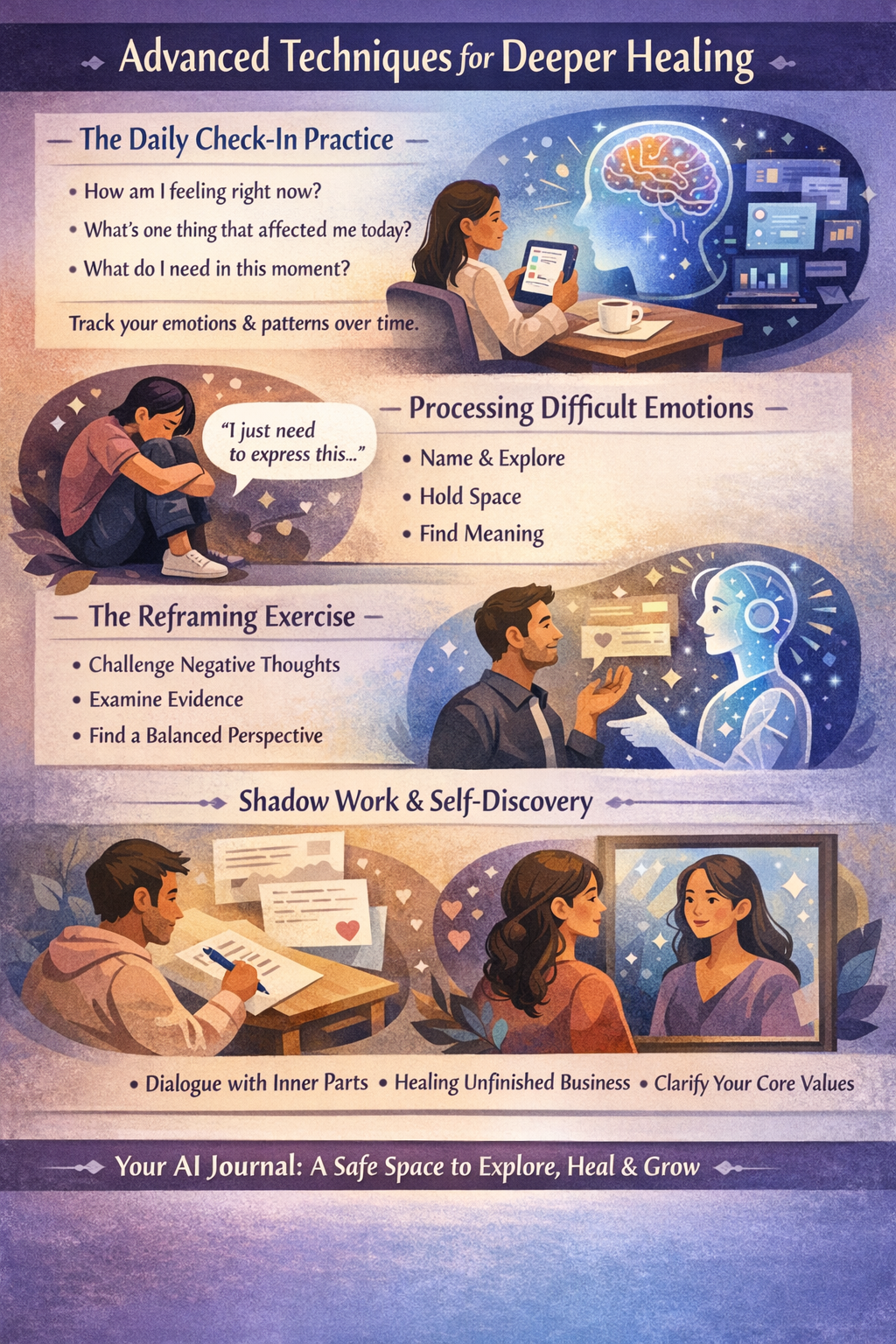
The Reframing Exercise
When negative thought patterns dominate, work with AI to practice cognitive reframing:
- Express the negative thought or belief
- Ask the AI to help you examine evidence for and against it
- Explore alternative interpretations together
- Develop a more balanced perspective
This isn’t about toxic positivity or denying real problems. It’s about developing cognitive flexibility and escaping thought traps that increase suffering without adding value.
Shadow Work and Self-Discovery
Use AI journaling for deeper psychological exploration:
Parts Work: Dialogue with different aspects of yourself. “There’s a part of me that wants to quit my job, and another part that’s terrified of change. Can you help me have a conversation between these parts?”
Unfinished Business: Write letters you’ll never send—to people you’re angry with, younger versions of yourself, future versions of who you want to become. The AI can help you process and respond to what emerges.
Value Clarification: “I want to understand what truly matters to me. Can you ask me questions that help me identify my core values?” Use the AI’s questions to excavate what drives your decisions and fulfillment.
Navigating Common Concerns
“Isn’t This Just Avoiding Real Human Connection?”
AI journaling works best as a complement to, not replacement for, human relationships and professional support. Think of it as an additional tool in your wellness toolkit.
The AI journal is there for the 2 AM panic attack when you can’t call a friend. It’s there for the daily emotional processing that would overwhelm any single person to provide. It helps you organize thoughts before therapy sessions, making that limited time with your therapist more productive.
Many people actually find that AI journaling improves their human relationships by helping them process emotions independently first, so they can communicate more clearly with others.
“What About Privacy?”
Choose platforms with strong privacy policies. Understand that conversations may be used to improve AI systems (usually in anonymized form). If privacy is a primary concern, look for platforms offering end-to-end encryption or local AI options.
For extremely sensitive topics, you might combine approaches—using AI for structure and general processing while reserving the most private details for offline traditional journaling or therapy.
“Can AI Really Understand My Emotions?”
AI doesn’t experience emotions, but it’s trained on vast amounts of human communication and can recognize patterns, offer relevant responses, and ask helpful questions. The healing doesn’t come from the AI “feeling” your pain—it comes from the process of articulating your experience, exploring it through dialogue, and gaining new perspectives.
Think of it like a well-designed meditation app. The app doesn’t meditate, but it can guide you effectively through the practice.
Measuring Your Progress
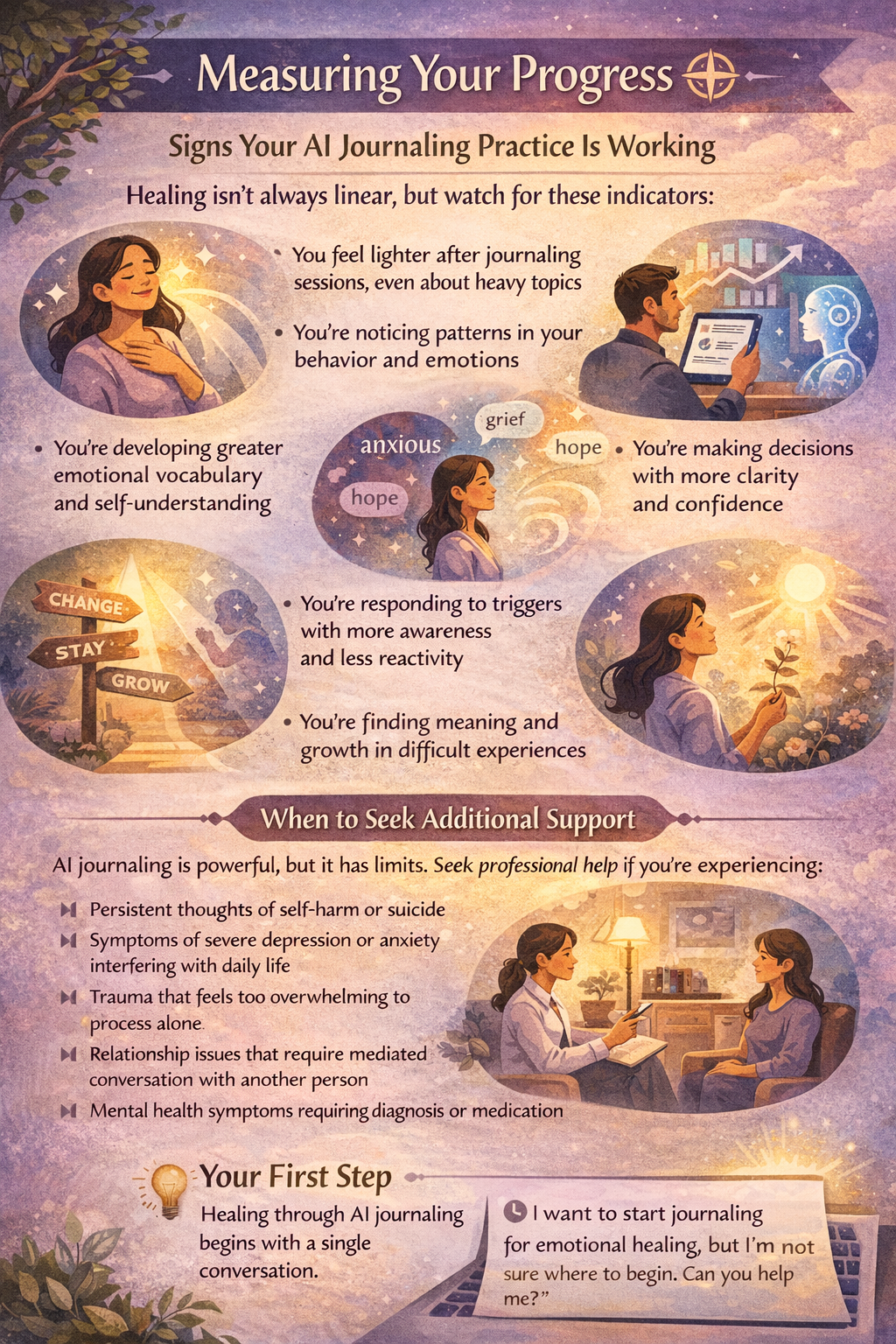
Signs Your AI Journaling Practice Is Working
Healing isn’t always linear, but watch for these indicators:
- You feel lighter after journaling sessions, even about heavy topics
- You’re noticing patterns in your behavior and emotions
- You’re developing greater emotional vocabulary and self-understanding
- You’re making decisions with more clarity and confidence
- You’re responding to triggers with more awareness and less reactivity
- You’re finding meaning and growth in difficult experiences
When to Seek Additional Support
AI journaling is powerful, but it has limits. Seek professional help if you’re experiencing:
- Persistent thoughts of self-harm or suicide
- Symptoms of severe depression or anxiety interfering with daily life
- Trauma that feels too overwhelming to process alone
- Relationship issues that require mediated conversation with another person
- Mental health symptoms requiring diagnosis or medication
Use your AI journal to help articulate what you’re experiencing, which can make it easier to explain to a healthcare provider.
The Future of Healing Through AI-Assisted Writing
As AI technology evolves, we’re likely to see even more sophisticated tools for emotional processing and personal growth. Voice-based journaling, multimodal emotional recognition, and increasingly nuanced conversational capabilities will make these practices even more accessible and effective.
What remains constant is the fundamental human need to be heard, to make sense of our experiences, and to grow through reflection. AI journaling harnesses technology to serve these timeless needs in new ways.
Your First Step
Healing through AI journaling begins with a single conversation. You don’t need to have everything figured out. You don’t need to know exactly what you’re feeling or what you want to explore. You simply need to show up and start.
Open a conversation with an AI platform. Type: “I want to start journaling for emotional healing, but I’m not sure where to begin. Can you help me?”
Then follow where the conversation leads. Be curious. Be honest. Be willing to explore beneath the surface of your first thoughts.
The journey of a thousand miles begins with a single step. Your healing journey can begin with a single typed sentence.
The practice of journaling with AI represents a democratization of therapeutic tools—putting powerful techniques for self-discovery and emotional healing into everyone’s hands, available whenever you need support. While it doesn’t replace professional mental health care or meaningful human connection, it offers an additional pathway toward the self-awareness, emotional processing, and personal growth that we all deserve.
In a world that often moves too fast for adequate reflection, AI journaling creates space to slow down, look inward, and tend to the landscape of your inner life. It’s not about the technology itself—it’s about what the technology enables: a consistent, judgment-free practice of turning toward yourself with curiosity and compassion, discovering who you are beneath the noise, and writing your way toward wholeness.